Published: October 10, 2026
Quick answer
In the United States, one standard drink contains 14 grams of pure alcohol, approximately 0.6 U.S. fluid ounces. That is roughly 12 fl oz of 5% beer, 5 fl oz of 12% wine, or 1.5 fl oz of 40% spirits. A large pour or stronger beverage can contain more than one standard drink. To describe your intake accurately, record the amount consumed, alcohol by volume (ABV), and timing—not just the number of glasses. Counting drinks measures alcohol intake; it does not establish a personally safe amount. (rethinkingdrinking.niaaa.nih.gov)
Safety first: Do not calculate drinks before getting help for possible heart attack or stroke symptoms. Call 911 for chest pain or pressure, shortness of breath suggesting a heart attack, or sudden face drooping, arm weakness, or speech difficulty. Do not assume these symptoms are simply an effect of drinking. (heart.org)
1. A standard drink measures alcohol, not glasses
A “standard drink” is a way to describe a fixed amount of pure alcohol, also called ethanol. It is not necessarily one can, one restaurant serving, or one cocktail. The U.S. definition lets different beverages be compared using the amount of alcohol they contain. (rethinkingdrinking.niaaa.nih.gov)
These servings each contain approximately one U.S. standard drink:
| Beverage | Amount | Alcohol strength |
|---|---|---|
| Beer | 12 U.S. fl oz | 5% ABV |
| Wine | 5 U.S. fl oz | 12% ABV |
| Distilled spirits | 1.5 U.S. fl oz | 40% ABV |
The strength matters as much as the volume. These examples do not mean that every beer, wine, or spirit has the listed ABV. Check the actual beverage rather than relying on its category. (cdc.gov)
For someone discussing atrial fibrillation (AFib), an irregular heart rhythm, this distinction improves communication. “Two glasses of wine” leaves the pour size and strength unanswered. “Two measured 8-ounce pours of 14% wine” gives a clinician enough information to estimate the alcohol consumed. NIAAA advises clinicians to clarify standard-drink sizes because people can unintentionally underestimate their intake. (heart.org)
2. Find the serving volume and ABV before calculating
ABV means alcohol by volume: the percentage of a beverage’s total volume that is pure alcohol. For example, 12% ABV means that 12% of the liquid’s volume is alcohol. Labels may use “alc/vol” or similar wording. (nhs.uk)
Start with two pieces of information:
- Volume actually consumed: the full container if you finished it, or the measured portion you drank.
- ABV of that beverage: read the label or ask the server. If the strength is unknown, say so rather than assigning an exact count. Without the concentration, the count cannot be calculated reliably. (health.gov.au)
Using the U.S. definition, the calculation is:
U.S. standard drinks ≈ U.S. fluid ounces consumed × ABV as a decimal ÷ 0.6
For 5% ABV, use 0.05, not 5. Multiplying volume by the decimal ABV gives the volume of pure alcohol; dividing by 0.6 converts it into approximate U.S. standard drinks. This formula is derived from NIAAA’s definition and the meaning of ABV. (rethinkingdrinking.niaaa.nih.gov)
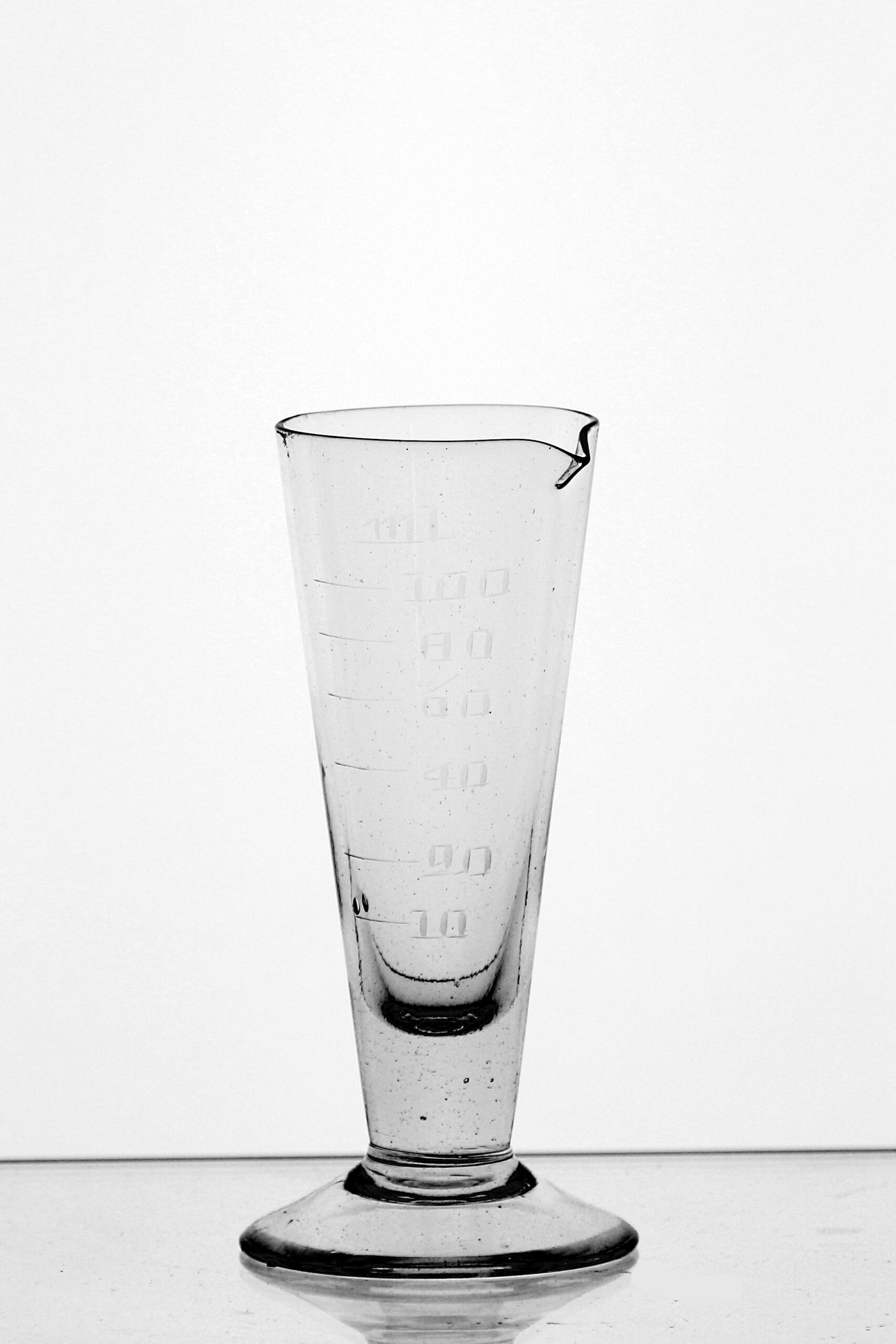
Use a measuring cup or marked measure to check a home pour; glass capacity alone does not tell you how much was poured. If your measurements are in milliliters, NIAAA’s drink-size calculator accepts those too. Do not mix milliliters with a formula written for U.S. fluid ounces. (rethinkingdrinking.niaaa.nih.gov)

3. Worked examples: wine, strong beer, and a multi-spirit cocktail
The following are hypothetical measured servings, not recommended portions. Their standard-drink counts are calculations, not estimates of AFib risk.
A large wine pour
Suppose you drink 8 U.S. fl oz of wine labeled 14% ABV.
8 × 0.14 ÷ 0.6 = 1.87
Rounded to one decimal place, that glass contains about 1.9 U.S. standard drinks. Two identical pours would total about 3.7, even though you used only two glasses. The calculation uses NIAAA’s 0.6-fluid-ounce definition. (rethinkingdrinking.niaaa.nih.gov)
The practical check is to confirm both the pour and the label. An 8-ounce pour of 14% wine cannot be counted using the familiar 5-ounce, 12% example.
A strong beer in a larger can
Suppose you finish 16 U.S. fl oz of beer labeled 8% ABV.
16 × 0.08 ÷ 0.6 = 2.13
That single can contains about 2.1 U.S. standard drinks. Both its larger volume and higher strength increase the alcohol count compared with a 12-ounce, 5% beer. (cdc.gov)
Check the container size as well as ABV. “One beer” does not distinguish these servings.
A cocktail containing several alcoholic ingredients
Suppose a measured cocktail contains:
- 1 U.S. fl oz of vodka at 40% ABV;
- 1 U.S. fl oz of rum at 40% ABV;
- 0.5 U.S. fl oz of liqueur at 20% ABV.
Calculate each ingredient’s pure alcohol volume and add them:
(1 × 0.40) + (1 × 0.40) + (0.5 × 0.20) = 0.90 fl oz
Then convert the total:
0.90 ÷ 0.6 = 1.5 U.S. standard drinks
This hypothetical cocktail contains 1.5 standard drinks. Adding an alcohol-free mixer changes the finished drink’s volume but does not remove the alcohol already added. Actual cocktail recipes vary; NIAAA notes that one cocktail can contain one, two, or more standard drinks. (rethinkingdrinking.niaaa.nih.gov)
4. “Standard drink” means different things in different countries
A drink count needs its definition attached. The United States and Australia use different standard-drink sizes, while the United Kingdom commonly describes intake in alcohol units. (rethinkingdrinking.niaaa.nih.gov)
| Country | Measurement | Pure alcohol represented |
|---|---|---|
| United States | One standard drink | 14 grams |
| Australia | One standard drink | 10 grams |
| United Kingdom | One alcohol unit | About 8 grams, or 10 mL |
These are measurement conventions, not interchangeable serving sizes or personal safety limits. (rethinkingdrinking.niaaa.nih.gov)
For a mass-based comparison, 28 grams of alcohol equals two U.S. standard drinks, 2.8 Australian standard drinks, or approximately 3.5 UK units. The alcohol amount is unchanged; only the counting system differs.
When completing a questionnaire or reading research, look for the stated definition. If it is missing, do not assume that “drinks per week” means U.S. standard drinks. For your clinician, keeping the original volume and ABV alongside your calculated count avoids this ambiguity.
5. Why counting glasses can distort alcohol research
Serving-size variation is not just a mathematical possibility. A measurement study published in 2008 examined drinks purchased at 80 establishments across 10 Northern California counties. Researchers measured beverage volumes and determined alcohol concentrations using brand information or sample analysis. (pubmed.ncbi.nlm.nih.gov)
In that study, wine servings contained an average of 43% more alcohol than one U.S. standard drink, and mixed spirits drinks contained 42% more. Those findings show why a reported “drink” may not match a standardized alcohol amount. (pubmed.ncbi.nlm.nih.gov)
The limits matter: this was an older, geographically restricted measurement study—not an AFib trial or a current survey of every restaurant. Its averages cannot tell you what was in your particular glass. It also did not measure the probability of a rhythm episode after drinking.
The useful lesson is narrower: volume and strength help interpret a drink count. That is why an exact label and a measured pour are more informative than assuming every serving contains one standard drink.
6. Keep a simple alcohol-and-symptom record for your clinician
You do not need a complicated spreadsheet. NIAAA offers an alcohol-consumption tracker; a notebook or phone note can also hold the details you want to discuss. (rethinkingdrinking.niaaa.nih.gov)
Consider recording:
- the date and approximate start and finish times;
- beverage type, container or pour size, and ABV;
- how much you actually consumed, including refills;
- the estimated standard-drink count and country definition used;
- any uncertainty, such as an unmeasured restaurant pour;
- when symptoms started, what they felt like, and approximately how long they lasted;
- any rhythm recordings you already have, without delaying care to obtain them.
The timing is worth retaining: NIAAA identifies how much, how fast, and how often someone drinks as relevant parts of alcohol assessment. (niaaa.nih.gov)
A hypothetical note could read:
“Between about 7 and 9 p.m., I drank two measured 8-ounce pours of wine labeled 14% ABV—approximately 3.7 U.S. standard drinks. I noticed a racing heartbeat at about 10 p.m. I did not record the rhythm.”
That is clearer than “two drinks caused my AFib.” Symptoms alone do not establish AFib or prove their cause; clinical assessment may include an electrocardiogram (ECG) or other rhythm testing. (heart.org)
If you do not know a serving’s size, write “unknown” or “estimated.” An honest estimate is preferable to false precision. For a future comparison, you can measure water in the same home glass—there is no need to drink alcohol to check its pour volume.
7. Use the count to ask better questions—not to set a safe allowance
Standard-drink counting helps describe alcohol intake. It does not tell you whether another drink is safe, whether palpitations are harmless, or whether alcohol was the only contributor to an episode. NIAAA states that there is no guaranteed safe amount of alcohol for everyone. (niaaa.nih.gov)
The 2023 U.S. AFib guideline recommends minimizing or eliminating alcohol for people with diagnosed AFib who are pursuing a rhythm-control strategy, to reduce recurrence and the amount of AFib they experience. That is not a universal safe-drinking threshold. (professional.heart.org)
Useful questions for your clinician include:
- “Given my symptoms or diagnosed AFib, should I avoid alcohol?”
- “Does this record describe my intake clearly enough?”
- “What should I do if palpitations happen again?”
- “Do I need an ECG or longer rhythm monitoring?”
- “Could alcohol interact with any of my medicines?”
Before an appointment, check for common counting mistakes: treating every container as one drink, using the example ABV instead of the actual label, overlooking top-ups, or counting a cocktail without all its alcoholic ingredients. Keep approximate answers approximate.
If you have been drinking heavily for a prolonged period, seek medical help before abruptly stopping. Alcohol withdrawal can be life-threatening, and a clinician can help plan a safer change. This warning is not a reason to continue drinking through urgent symptoms. NIAAA explains withdrawal concerns and professional support.
The goal is a clearer conversation, not a perfect number: bring the volume, strength, timing, symptoms, and uncertainties, and let the clinical assessment guide the next steps.